
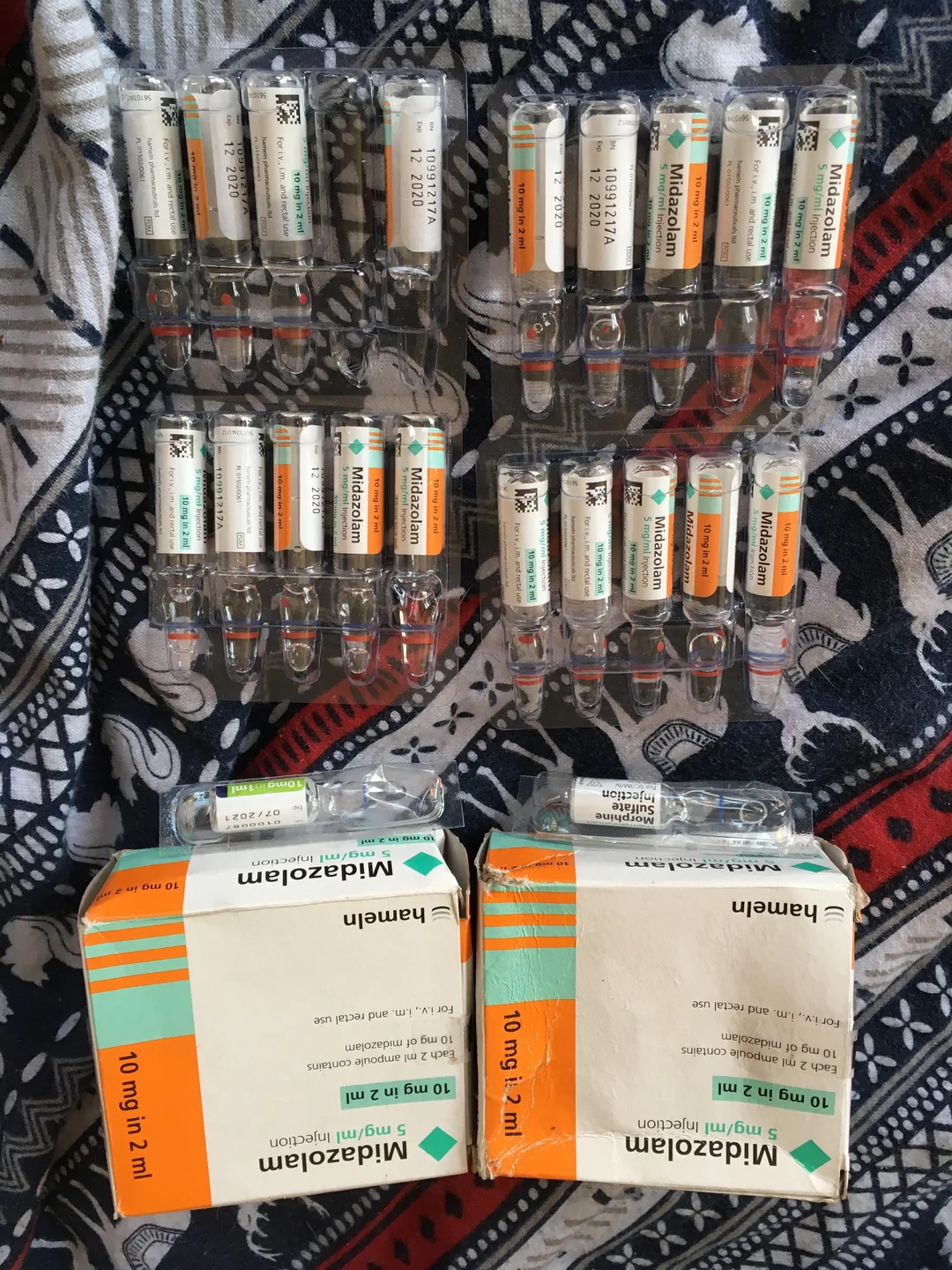
Midazolam 5 mg/ml injection
Midazolam 5 mg/mL Injection is a benzodiazepine formulation used by healthcare professionals for sedation and other approved clinical purposes. It can produce calming, sedative, and amnestic effects. Because midazolam can affect breathing and consciousness, trained medical professionals should administer and monitor its use appropriately.
$135.57 Original price was: $135.57.$125.98Current price is: $125.98.
What Is Midazolam 5 mg/mL Used For?
Midazolam 5 mg/mL is an injectable benzodiazepine that healthcare professionals use for sedation, anxiety relief, and certain medical procedures. It can help patients relax and may cause drowsiness and amnesia during treatment. Some formulations also treat specific seizure emergencies, depending on their approved indication and route. The concentration means each 1 mL contains 5 mg of midazolam; it does not represent the prescribed dose. Clinicians select and administer the appropriate dose based on the patient and treatment purpose.
How long does midazolam last
Midazolam usually produces short-acting sedation, but the duration varies with the dose, route, patient factors, and other medicines. After intramuscular administration, blood concentrations typically peak at about 30 minutes. The sedative effects may continue for several hours, while impaired alertness or memory can last longer. Healthcare professionals monitor patients during recovery because midazolam can cause respiratory depression, especially when combined with opioids or other central nervous system depressants.
How Midazolam Works
Midazolam works by enhancing the activity of GABA, a chemical messenger that reduces excessive activity in the brain. As a benzodiazepine, it binds to specific sites on GABA-A receptors and strengthens GABA’s calming effects. This action slows central nervous system activity and produces sedation, relaxation, reduced anxiety, and amnesia. The medicine can also help control certain seizures. Its effects depend on the dose, administration route, and other medicines the patient receives.
- Enhances GABA activity – Midazolam strengthens GABA’s inhibitory effects in the brain.
- Slows brain activity – It reduces excessive central nervous system activity.
- Produces sedation – It helps patients become calm and drowsy.
- Reduces anxiety – It produces an anxiolytic effect.
- Causes amnesia – It can reduce memory formation around medical procedures.
- Relaxes the body – Its CNS effects can promote muscle relaxation.
- Helps control seizures – Certain formulations can treat seizure emergencies.
- Acts relatively quickly – IV administration can produce sedation within minutes.
- Effects vary – Dose, route, and other medicines can change its effects.
How does midazolam work during a seizure?
Midazolam is a benzodiazepine that potentiates the inhibitory effect of gamma-aminobutyric acid (GABA) at GABA-A receptors.
This increases inhibitory neurotransmission in the central nervous system and can rapidly reduce abnormal neuronal activity.
Clinically, the intended effect during seizure rescue is to terminate or suppress ongoing seizure activity. Sedation and reduced consciousness are expected pharmacologic effects and should not automatically be interpreted as treatment failure.
Midazolam side effects
Midazolam can quickly suppress ongoing seizure activity and produce calming effects. It may cause sedation, reduced consciousness, anxiety relief, muscle relaxation, and temporary memory loss. The response varies with the patient and treatment circumstances. For status epilepticus, healthcare professionals should administer an indicated benzodiazepine promptly because prolonged seizures can become harder to control and may cause serious complications.
- Seizure control: Helps suppress ongoing seizure activity.
- Sedation: Can make patients drowsy or less conscious.
- Anxiety relief: Produces a calming effect.
- Muscle relaxation: Reduces muscle activity.
- Memory effects: May cause temporary amnesia.
- Response variation: Effects depend on dose, age, health, route, and other medicines.
- Close monitoring: Healthcare professionals monitor breathing and cardiovascular function because serious respiratory effects can occur.
How to use Midazolam 5 mg/mL IV
IV midazolam should be administered by trained healthcare professionals in an appropriately monitored clinical environment.
Before administration:
- Confirm the indication and prescribed dose.
- Verify the concentration on the ampoule or vial.
- Calculate the volume required from the prescribed dose and concentration.
- Assess airway, breathing, circulation, oxygenation, and relevant comorbidities.
- Review concomitant CNS depressants, particularly opioids and other sedatives.
- Ensure appropriate monitoring and immediate access to airway and resuscitation equipment.
During and after administration, monitor the patient’s respiratory and cardiovascular status and clinical response. Rapid IV administration or excessive dosing can increase the risk of respiratory depression, airway obstruction, apnea, and cardiovascular instability.
Important point about a “5 mg dose”
A 5 mg/mL product is not the same thing as a 5 mg dose.
With a 5 mg/mL solution, a 5 mg dose corresponds mathematically to 1 mL, but whether 5 mg is an appropriate clinical dose depends on the patient’s age, weight, indication, previous benzodiazepine exposure, clinical condition, and the applicable protocol or product information.
Therefore, healthcare professionals should not select a dose simply because the product is labeled “5 mg/mL.”
Is 5 mg the best IV dose?
There is no universally “best 5 mg dose” of IV midazolam for every patient with a seizure.
The appropriate dose is patient- and protocol-dependent. Status epilepticus treatment algorithms may use different benzodiazepines, doses, routes, and repeat-dose strategies depending on the patient and clinical setting.
The U.S. FDA-approved SEIZALAM product, for example, has a labeled adult status-epilepticus dose of 10 mg intramuscularly, illustrating why the concentration, route, formulation, indication, and dose must be considered separately.
For an IV 5 mg/mL product, clinicians should follow the specific manufacturer’s prescribing information and their institutional status-epilepticus protocol rather than applying an internet-generated fixed dose.
Safety considerations
Respiratory depression
The most important acute safety concern is respiratory depression. IV midazolam can cause hypoventilation, airway obstruction, apnea, and respiratory arrest, particularly after excessive doses or rapid IV administration.
Cardiovascular effects
Hypotension and other changes in cardiovascular function can occur, particularly in vulnerable patients or when midazolam is combined with other sedating medicines.
Additive CNS depression
Concurrent use with opioids, alcohol, anesthetics, or other CNS depressants can increase sedation and cardiorespiratory depression. Careful clinical assessment and monitoring are required.
Older, debilitated, or medically compromised patients
These patients may have greater sensitivity to midazolam and may require individualized dosing and closer monitoring.
Drug interactions
Midazolam is substantially metabolized through CYP3A pathways. CYP3A inhibitors can increase exposure, while CYP3A inducers can reduce exposure. The complete medication history should therefore be reviewed when clinically feasible.
What should be monitored?
Depending on the emergency setting and local protocol, monitoring may include:
- Respiratory rate and respiratory effort
- Oxygen saturation
- Airway patency
- Level of consciousness
- Blood pressure
- Heart rate and cardiac rhythm
- Capnography where available and appropriate
- Ongoing clinical or electrographic seizure activity when indicated
Resuscitation equipment and personnel capable of airway management should be immediately available when administering parenteral midazolam.
Key clinical takeaway
Midazolam 5 mg/mL is a concentration, not a universal seizure-rescue dose. For IV seizure management, the clinician should verify the exact product, indication, prescribed dose, route, patient factors, and local status-epilepticus protocol. The benefit of rapid seizure control must be balanced against potentially serious respiratory and cardiovascular adverse effects.
Frequently Asked Questions About Midazolam 5 mg/ml injection
1. What is Midazolam 5 mg/mL injection used for?
Midazolam injection is a short-acting benzodiazepine used in several clinical settings. In emergency and critical-care practice, midazolam may be used for seizure control, including status epilepticus, depending on the specific product, route, indication, and applicable local authorization or protocol.
2. How many milligrams are in 1 mL of Midazolam 5 mg/mL?
One milliliter contains 5 mg of midazolam. The volume required for administration should be calculated from the prescribed dose. The concentration itself does not establish the appropriate clinical dose.
3. Can Midazolam 5 mg/mL be given intravenously for seizures?
Some midazolam injection products are used intravenously for seizure management under applicable clinical protocols, but the authorized route and indication vary by product and country. Healthcare professionals should check the specific product information before administration. The U.S. SEIZALAM labeling, for example, specifies intramuscular administration for adult status epilepticus.
4. What are the most important adverse effects of IV midazolam?
The most clinically important adverse effects include sedation, respiratory depression, airway obstruction, apnea, and hypotension. The risk increases with excessive dosing, rapid IV administration, and concomitant CNS depressants.
5. Why does IV midazolam require respiratory monitoring?
Midazolam can depress the central nervous system and reduce respiratory drive. Serious respiratory complications can develop rapidly, so patients receiving parenteral midazolam should be appropriately monitored and treated in an environment with airway and resuscitation capability.
6. Is Midazolam 5 mg/mL the same as a 5 mg dose?
No. “5 mg/mL” identifies the drug concentration. A 5 mg dose would equal 1 mL of a 5 mg/mL solution, but the clinically appropriate dose may be different. Dose selection must be based on the indication, patient characteristics, product information, and institutional protocol.
Frequently asked questions
Use a legitimate healthcare provider and a licensed pharmacy that follow applicable prescription requirements. Be cautious of websites offering prescription phentermine without a medical evaluation.
You can contact local licensed pharmacies or use their official pricing tools to compare the current cash price for your prescribed medication. Prices can change and may differ between pharmacies.
Coverage depends on your insurance plan and its prescription-drug policies. Some plans may exclude medications used for weight management, so checking your formulary is the most reliable way to determine coverage.
Generic phentermine may cost less than some brand-name alternatives, although prices vary considerably between pharmacies and locations.
A licensed retail or mail-order pharmacy may be able to fill a valid prescription, subject to local laws, pharmacy policies, and medication availability.
In some regions, legitimate telehealth services can evaluate patients for prescription weight-management medications. Prescription requirements depend on local regulations and the clinician's assessment.
The cost varies by pharmacy, location, insurance coverage, quantity, and whether you receive a generic version. Comparing licensed pharmacies can help you find the applicable cash price.





Reviews
Clear filtersThere are no reviews yet.